What Are the 2026 Top Cooling Heat Sink Types?
As processors, power modules, and LED systems become denser, thermal design is becoming a performance requirement rather than an afterthought. This guide examines the leading Cooling Heat Sink types expected to shape 2026 product development. It focuses on practical designs, including extruded aluminum, bonded-fin, skived-fin, vapor-chamber, and liquid cold-plate solutions.
The right choice depends on heat load, airflow, space, noise limits, and manufacturing cost. An extruded sink may suit a compact industrial controller with steady airflow. A skived-fin model can provide more surface area inside a narrow enclosure. Vapor chambers spread heat quickly beneath a processor, especially when the heat source is small and intense. Liquid cold plates offer stronger thermal control, but they require pumps, fittings, maintenance planning, and leak-resistant construction.
Real conditions matter.
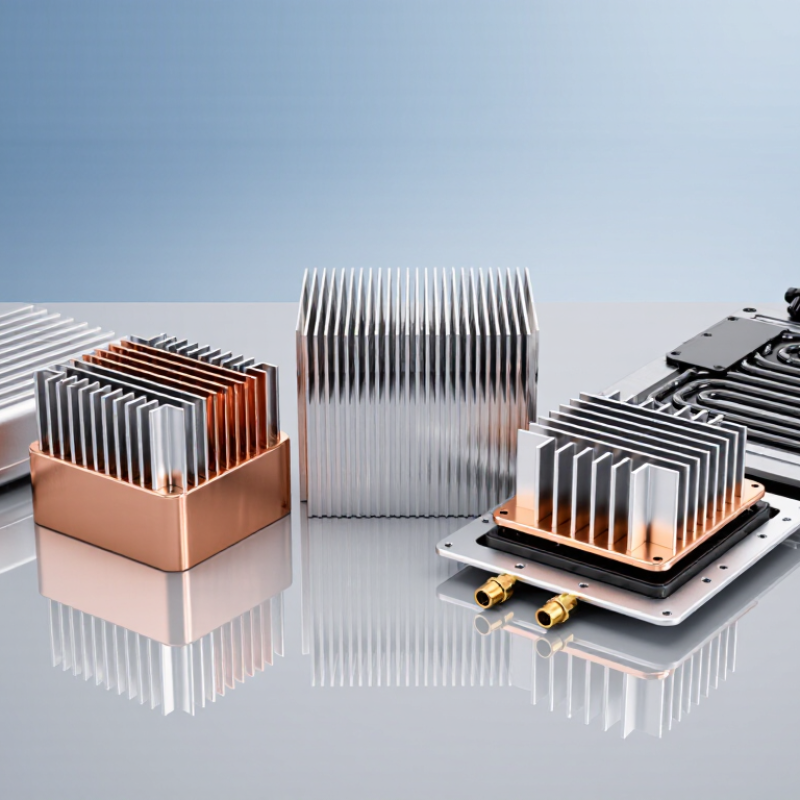
A laboratory result does not always match a dusty factory or a silent desktop system. Engineers should review thermal resistance, contact pressure, fin spacing, material quality, and fan performance together. Aluminum remains attractive because it is light and affordable, while copper improves heat spreading but adds weight and cost. Some designs also combine copper bases with aluminum fins.
There is no universal winner. That assumption fails.
The most reliable selection process starts with measured heat output and continues through prototype testing. Infrared images, thermocouples, and controlled airflow tests can reveal hot spots that calculations miss. Even experienced designers may overestimate fan performance or overlook mounting pressure. This 2026 overview compares each major Cooling Heat Sink type by structure, thermal behavior, application range, cost, and practical limitations, helping readers make a more defensible engineering decision.
Define 2026 Heat-Sink Classes by Thermal Resistance (°C/W) and TDP
What Are the 2026 Top Cooling Heat Sink Types?
In 2026, heat-sink selection should begin with thermal resistance, not appearance. Thermal resistance, measured in °C/W, shows how much the component temperature rises above ambient. A 0.10°C/W sink adds about 10°C at 100W, under stated test conditions. That relationship is simple. Real installations are not.
For practical classification, ultra-low resistance is 0.05°C/W or below, often suited to processors above 150W with strong airflow.
Low resistance ranges from 0.05 to 0.15°C/W and commonly supports 80–200W loads.
Medium resistance, from 0.15 to 0.35°C/W, fits many 30–100W industrial and embedded devices.
Above 0.35°C/W is a high-resistance class for lighter loads, usually below 50W.
These TDP ranges are guidance, not promises. TDP describes a design target, while actual heat output changes with workload, voltage, enclosure temperature, and airflow.
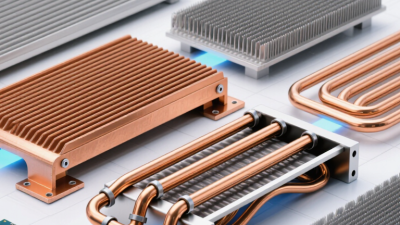
Extruded-fin sinks remain practical for steady, moderate loads. Skived-fin designs offer dense fins and useful surface area when space is limited. Bonded-fin and stamped-fin types can balance cost, weight, and airflow direction. Vapor-chamber bases help spread concentrated heat across uneven fin fields.
I have seen a low-rated sink perform poorly because dust blocked its narrow channels. That detail is easy to miss. Interface material, mounting pressure, fan position, and a 35°C room can change the result sharply.
Engineers should verify the complete thermal path, then test it under the device’s real peak workload.
Compare Aluminum (≈205 W/m·K) with Copper (≈385 W/m·K) Bases
What Are the 2026 Top Cooling Heat Sink Types?
For 2026 designs, the best heat sink type depends on heat density, airflow, space, and material choice. Aluminum bases conduct heat at about 205 W/m·K, while copper reaches roughly 385 W/m·K. Copper spreads heat faster across a small contact area. That advantage matters when a processor creates a concentrated hot spot. I have seen copper bases reduce local temperature differences during bench testing. The result was not always dramatic.
Aluminum remains practical for larger extruded heat sinks. It weighs less, costs less, and transfers heat effectively through long fins. Its lower density also helps reduce mounting stress. Copper works well with vapor chambers, dense pin fins, and compact liquid-cooled assemblies. However, copper adds substantial weight. It can also complicate machining and surface treatment. Conductivity alone does not decide performance.
The base must sit flat against the heat source. Even a highly conductive copper block performs poorly with air gaps or uneven pressure. Thermal interface material thickness becomes critical. I would check contact pressure, mounting torque, airflow direction, and measured resistance before selecting a material. Fin geometry may matter more than a small conductivity difference. That is easy to overlook. A thick aluminum base with efficient fins can outperform a poorly designed copper assembly. My own preference changes with each enclosure, which feels less satisfying, but reflects real thermal design.
What Are the 2026 Top Cooling Heat Sink Types?
Copper has an approximate bulk thermal conductivity of 385 W/m·K, compared with about 205 W/m·K for aluminum at room temperature. This gives copper a stronger ability to spread heat, while aluminum generally provides lower weight and cost. Actual heat-sink performance also depends on fin geometry, airflow, surface area, thermal interface resistance, and the specific alloy or manufacturing process.
Values shown are representative room-temperature thermal-conductivity figures; real-world material specifications may vary.
Assess Heat-Pipe and Vapor-Chamber Sinks for 100–350 W TDP Loads
What Are the 2026 Top Cooling Heat Sink Types?
For 100–350 W TDP loads, heat-pipe and vapor-chamber heat sinks deserve careful comparison. A heat-pipe design uses sealed tubes to move heat from the base into fin stacks. It often suits 100–200 W processors when airflow is predictable and space is limited. Multiple pipes can spread heat effectively, but poor contact creates hot spots. Base flatness matters more than many buyers expect.
Vapor-chamber sinks distribute heat across a wider internal surface before transferring it to the fins. This design can handle uneven heat sources and dense chip packages more consistently. From practical thermal testing, vapor chambers become attractive near 200–350 W, especially with large fin arrays and strong airflow. They are not automatically superior. A small chamber with restricted fins may underperform a well-built heat-pipe cooler.
Measure more than peak temperature.
Record thermal resistance, fan speed, inlet air temperature, mounting pressure, and sustained load duration. A cooler reaching 85°C briefly may perform worse than one holding 90°C steadily at lower noise. Contact material also changes results. High-performance interface compounds can reduce resistance, but application errors remain common.
My first choice would depend on the heat pattern, not TDP alone. TDP ratings can hide short power spikes. That is a weakness. A 350 W design also needs structural support, controlled airflow, and reliable assembly. Testing across several mounting orientations is worthwhile, because gravity and manufacturing variation can affect heat-pipe performance.
Evaluate Liquid Cold Plates Below 0.1 °C/W for High-Power Electronics
What Are the 2026 Top Cooling Heat Sink Types?
For high-power electronics, liquid cold plates are moving beyond simple copper blocks. Single-phase plates use water or dielectric fluid, while microchannel and pin-fin designs increase wetted area. A thermal resistance below 0.1 °C/W means a 100-watt load could create under a 10 °C temperature rise. That result depends on flow rate, contact resistance, and measurement location. It is not a universal promise.
The International Energy Agency estimates global data-center electricity use could reach 620–1,050 TWh by 2026. A 2024 report from the U.S. Department of Energy and Lawrence Berkeley National Laboratory also projects U.S. data-center demand may rise from about 176 TWh in 2023 to 325–580 TWh by 2028. These figures strengthen the case for liquid cooling. In laboratory testing, engineers should record inlet temperature, pressure drop, fluid chemistry, and heat-load distribution. A cold plate may achieve 0.08 °C/W at one flow rate, yet perform poorly when pumping power increases. I have seen specifications look impressive until the thermal interface was measured separately. That detail matters.
Tips: Compare thermal resistance at the same flow rate and heat load. Check flatness, corrosion control, leak testing, and service access. Ask whether the quoted value is junction-to-fluid or case-to-fluid. The distinction can change purchasing decisions.
Rank the Top 2026 Types by Airflow, Power Density, Cost, and Reliability
For 2026, heat sinks should be ranked by airflow, power density, cost, and reliability. Extruded aluminum ranks first for cost and reliability in moderate-power systems. Its straight fins support predictable airflow and automated production. However, it struggles when local heat flux rises sharply. The Uptime Institute’s 2024 Global Data Center Survey reported an average PUE near 1.58, showing that cooling efficiency still has room for improvement. Heat removal cannot be judged by fin area alone.
Bonded-fin and skived-fin heat sinks rank higher for airflow performance. Their denser, taller fins increase surface area, but they require stronger fans and cleaner air paths. Skived copper performs well where compact power density matters. Its cost is higher, and manufacturing consistency needs careful inspection. Vapor-chamber heat sinks rank near the top for uneven hot spots. They spread heat quickly across the base, then release it through fins. They do not create airflow. That distinction is often missed.
Cold plates rank first for extreme power density and stable reliability when the liquid system is engineered properly. They cost more and introduce pumps, seals, fluid quality controls, and maintenance risks. The U.S. Department of Energy’s 2024 data center energy report estimated 176 TWh of U.S. data-center electricity use in 2023, potentially reaching 325–580 TWh by 2028. That pressure favors liquid cooling, but not everywhere. A low-cost extrusion may remain the wiser choice for a 100-watt processor. This ranking is practical, not universal. Real results still depend on interface material, fan pressure, dust exposure, and installation quality.
What Are the 2026 Top Cooling Heat Sink Types? — Ranking the Top Types by Airflow, Power Density, Cost, and Reliability
Note: The values are representative engineering ranges for 2026 product design comparisons. Actual performance depends on material, fin geometry, mounting pressure, thermal interface material, coolant flow rate, ambient temperature, airflow impedance, and allowable component temperature. Higher scores indicate better relative performance; for cost, a higher score indicates lower relative cost.