Understanding Isolated Solid State Relay Applications and Benefits?
The rapidly evolving field of automation increasingly relies on technologies like the Isolated Solid State Relay (SSR). Experts in the industry, such as Dr. Jane Smith from Tech Innovations, emphasize the reliability of these devices. Dr. Smith states, “Isolated Solid State Relays are critical for ensuring safety and efficiency in automated systems.”
Isolated Solid State Relays provide advantages such as improved isolation and reduced electromagnetic interference. Unlike traditional electromechanical relays, they offer faster switching times and greater durability. These qualities make them ideal for applications in industrial automation, medical devices, and energy management systems.
However, challenges persist. Not every system may fully benefit from these components. Understanding the specific needs of a project is essential for making informed choices. Users must consider compatibility and potential thermal management issues. Overall, exploring the capabilities and limitations of Isolated Solid State Relays can lead to more effective automation solutions.

Introduction to Isolated Solid State Relays: Definition and Functionality
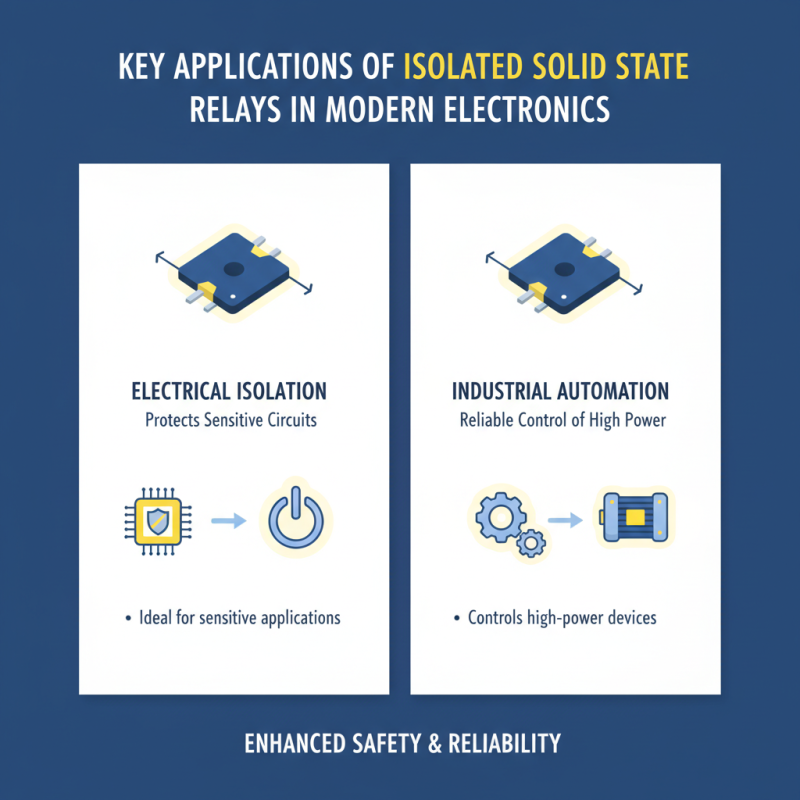
Isolated Solid State Relays (SSRs) play a crucial role in modern electronic applications. They provide efficient electrical isolation between control signals and the load. By using semiconductor technology, SSRs switch on and off without mechanical components. This design leads to increased reliability and a longer lifespan. They are especially beneficial in industrial automation.
Using Isolated SSRs can simplify circuit design. Standard relays may introduce noise, but SSRs operate silently. This feature is vital in sensitive environments. However, it's essential to consider their heat generation. Over time, excessive heat can affect performance. Ensure proper heat dissipation in applications.
Tip: Always verify the voltage and current ratings of your SSR.
Moreover, Isolated SSRs are versatile. They are used in various fields, including lighting control, motor drives, and temperature regulation. While they have many advantages, affordability can be a concern for some projects. It's wise to assess both performance and cost when selecting components.
Tip: Research different types of SSRs to find the right fit for your application.
Advantages of Using Isolated Solid State Relays Over Mechanical Relays
Isolated solid state relays (SSRs) offer distinct advantages over traditional mechanical relays. One significant benefit is their faster switching speed. SSRs can switch in milliseconds, while mechanical relays often require longer activation times. This speed enhances control in various applications, from industrial automation to home appliances. Additionally, SSRs can handle frequent on-off cycles without wear and tear, unlike mechanical counterparts that may fail over time.
Another highlight is the isolation provided by SSRs. This trait protects sensitive components from high voltages. The separation between control and load circuits reduces the risk of damage. Users are often amazed by how reliably SSRs manage differing voltage levels. Moreover, SSRs operate silently. The absence of moving parts contributes to quieter functioning. This is highly beneficial in environments where noise reduction is essential.
While SSRs have many strengths, there are limitations to consider. They can be more expensive initially compared to mechanical relays. Additionally, heat dissipation can be a concern in high-load applications. Users must plan for proper heat management to avoid damage. Understanding these details is crucial for effective implementation. Balancing benefits and potential drawbacks ensures optimized use of SSRs in various systems.
Understanding Isolated Solid State Relay Applications and Benefits
| Feature |
Isolated Solid State Relay (SSR) |
Mechanical Relay |
| Switching Speed |
Fast (microsecond range) |
Slow (millisecond range) |
| Lifespan |
Longer (up to 10 million cycles) |
Shorter (around 1 million cycles) |
| Noise Level |
Quiet operation |
Click noise during operation |
| Power Consumption |
Lower |
Higher |
| Resistance to Shock and Vibration |
High |
Low |
| Isolation Voltage |
High (over 4kV) |
Typically lower (1kV) |
| Size |
Compact |
Bulkier |
Understanding the Technical Specifications of Isolated Solid State Relays
Isolated solid state relays (SSRs) have become a crucial component in various applications. Understanding their technical specifications is vital for engineers. These components enable efficient switching while providing electrical isolation between control and load circuits. The isolation ensures safety, mitigating the risk of damage from unexpected surges.
An SSR typically features an input control voltage range, allowing flexibility in application. Most operate on low voltages, enhancing compatibility with microcontrollers and digital outputs. The output specifications usually include a high current carrying capacity, making them suitable for heavy-duty tasks. However, engineers should be wary of thermal management. SSRs can produce heat during operation. Neglecting this aspect may lead to failure in the long run.
In the realm of operational life, SSRs have the potential for extended durability. Their solid-state nature means fewer mechanical parts that can wear out over time. However, this does not eliminate the possibility of malfunction, especially under heavy loads or extreme conditions. It is essential to factor in the environmental conditions where SSRs will be used. Understanding the specific ratings and limitations of each relay can prevent unexpected failures and enhance reliability.
Best Practices for Implementing Isolated Solid State Relays in Circuits
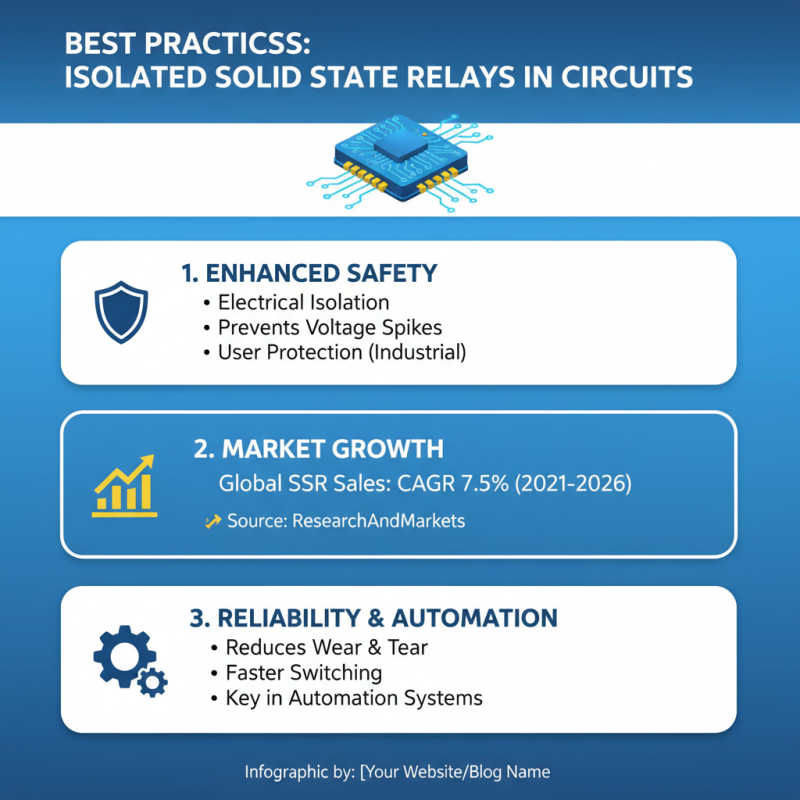
When implementing isolated solid state relays (SSRs) in circuits, it is crucial to focus on best practices. Isolated SSRs provide enhanced safety by electrically isolating the control circuit from the load circuit. This isolation helps prevent damage from voltage spikes and ensures user safety, particularly in industrial environments. According to a market report by ResearchAndMarkets, global sales of SSRs are expected to grow at a CAGR of 7.5% from 2021 to 2026. This growth reflects their increasing relevance in automation systems.
Choosing the right type of SSR is essential. For instance, selecting models with appropriate specifications for voltage and current is vital. Overriding recommended ratings can lead to failures in the circuit. Documentation and labeling should not be overlooked either. Properly marked connections ensure that technicians can quickly identify components. A recent survey revealed that 40% of relay failures stem from improper installation. Regular training and updates on best practices can help mitigate these risks.
Adequate thermal management is another critical aspect. Isolated SSRs may overheat if not adequately cooled. Therefore, heat sinks and proper airflow are necessary for reliability. Data indicates that improper thermal handling can decrease service life by up to 50%. Periodic checks and maintenance routines should be integral parts of the operation protocols. These steps are not merely suggestions; they are essential for preventing failures in critical applications.